Weighted Plank: how to do it right
In short: The weighted plank is an isometric brace for the rectus abdominis and deep muscles, loaded at mid-range, body aligned and forearms on the floor.
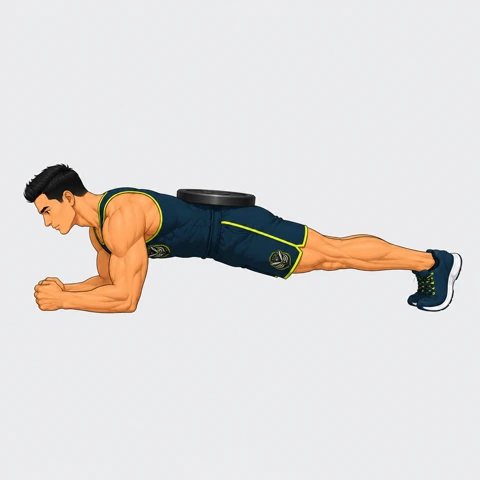
How to do it, step by step
- 1Place your forearms on the floor, elbows under your shoulders, shoulder-width apart.
- 2Align ankles, pelvis and neck in a straight line, eyes on the floor.
- 3Have a weight placed on your upper back or wear a weighted vest, without shifting your alignment.
- 4Squeeze your abs, glutes and quads, tuck the pelvis slightly to erase the arch.
- 5Hold the position still for the target time, then lower the pelvis under control.
The mistake to avoid
Don't let your hips sag toward the floor. Keep your body straight.
Other common mistakes
- Pelvis sagging and lower back arched: tuck the pubis toward the navel to lock the brace.
- Hips too high in a bridge: lower until shoulders, hips and ankles are aligned.
- Holding your breath until you shake: keep a continuous breath and abs tight.
- Weight placed too high on the neck: center the load on the middle of the back to spread the strain.
Muscles worked
- Main:
- Abs
The rectus abdominis works first to prevent the pelvis from arching. The transverse abdominis maintains a deep sheath around the trunk. The obliques stabilize laterally. The hip flexors and glutes help lock the alignment, shoulders and lower back are co-contracted.
What to replace it with
Same muscle, same part of the movement: these exercises do the same job.
- Decline Crunch ›
- Medicine Ball Slam ›
- Cable Pallof Press ›
- Cable Woodchop ›
- Rotational Medicine Ball Throw ›
Frequently asked questions
How do I do this exercise?
Forearms on the floor, elbows under your shoulders, shoulder-width apart. Align ankles, pelvis and neck in a straight line, eyes on the floor. Have the weight placed on the middle of your back or put on a weighted vest, squeeze abs, glutes and quads, tuck the pelvis slightly to erase the arch and hold still.
How low should I go?
On the plank there's no range to travel, you freeze a mid-range position: shoulders, hips and ankles on the same line. That's where the abs hold their maximum tension in anti-extension. If the pelvis sags you leave the effective zone and the lower back takes the hit, if the hips rise into a bridge you release the brace. Your job is to lock exactly this straight line.
I don't feel anything, is that normal?
You should feel your abs squeezed constantly to stop the pelvis from dropping. Think active contraction, not just waiting: deliberately squeeze your glutes and quads and tuck the pelvis as soon as you set up, it puts the abs under immediate tension. If you mostly feel your lower back, your pelvis is sagging, tuck the pubis toward the navel.
How do I breathe?
Breathe in small inhales and short exhales without ever releasing the abdominal brace. Keep stable intra-abdominal pressure, as if you were protecting your belly from a blow. Above all, don't hold your breath: the brace has to hold independently of breathing.
Do I need to warm up first?
Do a short plank with no weight to find your alignment and wake up the brace, then add the weight. If the plank comes after other trunk exercises, you're already warm and can start light.